Local-Specific Angles
Managing Towering Loblolly Pines Near Power Lines in North Georgia Subdivisions
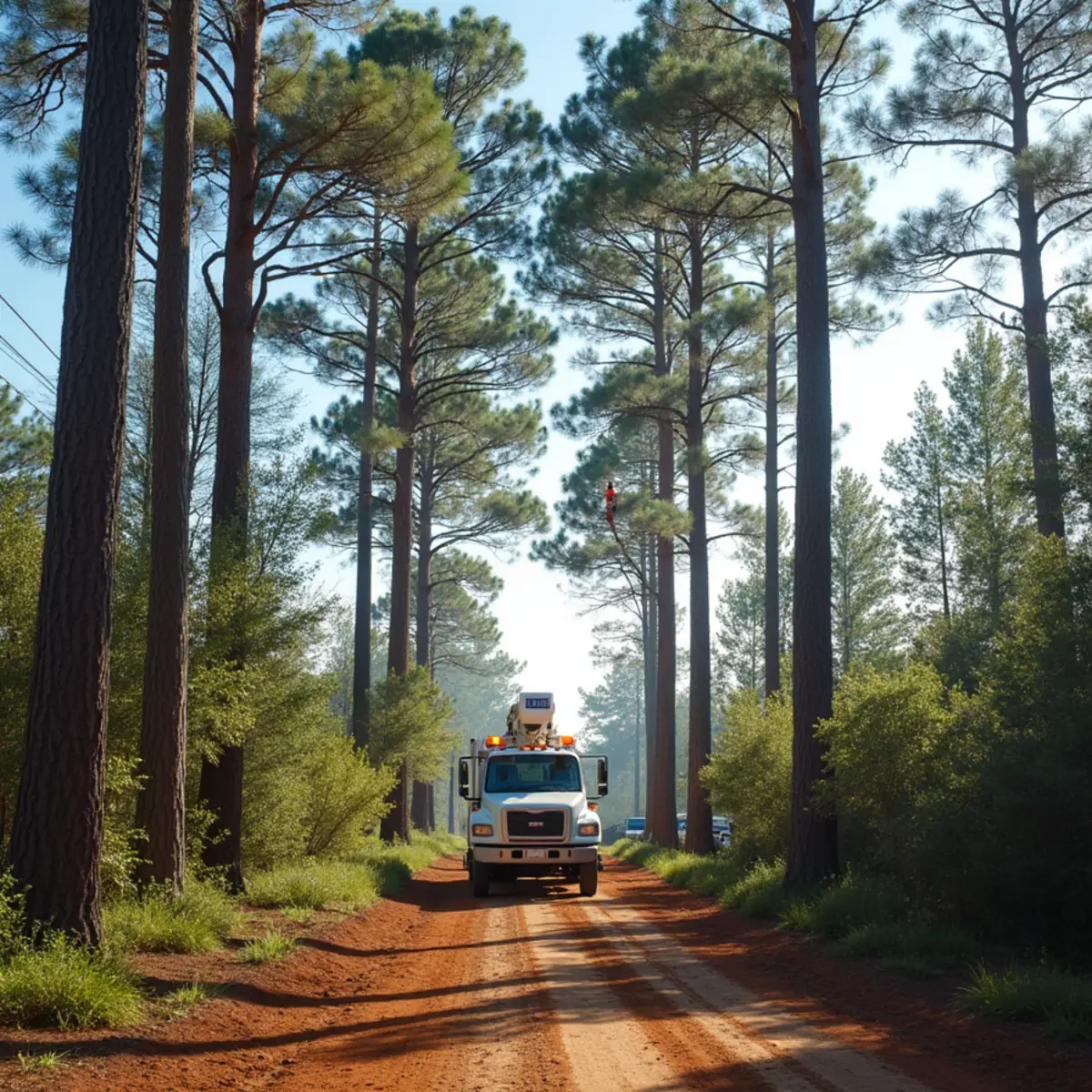
Towering loblolly pines and overhead power lines are a common and dangerous pairing in North Georgia subdivisions. Here is how clearance and removal are handled safely.
A Dangerous Pairing in North Georgia
Drive through almost any North Georgia subdivision and you will see them: loblolly pines that were saplings when the neighborhood was built and are now 80 to 100 feet tall, often standing directly beneath or beside the power lines that feed the street. It is one of the most common and most serious tree hazards in the region.
Loblolly pines grow fast and tall with a relatively slender trunk, and they are prone to snapping in ice, wind, and beetle stress. When one of those failures happens next to a power line, the result can be an outage, a fire risk, and a live-wire hazard on the ground.
Utility Line Contact Is a Life-Safety Issue
The most important rule around power lines is the simplest: assume any line a tree is touching is energized, and stay away from it. A downed or contacted line can remain lethal even when the neighborhood has lost power, and the ground around it can be energized too.
This is never a do-it-yourself situation. Homeowners are seriously injured every year trying to trim a branch near a line. When a tree contacts a line, the first call is to your utility, not to a saw.
Who Is Responsible for the Line?
Responsibility depends on which wires are involved. The high-voltage distribution lines along the street are generally maintained by the utility, which does its own vegetation clearance and will handle trees threatening those primary lines. The service drop, the lower-voltage line running from the pole to your house, is a different matter, and clearing trees around it often falls to the homeowner working with qualified crews.
Knowing the difference tells you whether to call the utility, call a tree service, or coordinate both. When in doubt, start with the utility so they can advise and de-energize if needed.
| Line type | Typical responsibility | First call |
|---|---|---|
| Primary distribution (street) | Utility vegetation crew | Utility |
| Service drop (pole to house) | Homeowner, with qualified crew | Utility, then tree service |
| Line already down or arcing | Utility emergency | Utility, then 911 if fire |
Clearance Pruning vs. Removal
For pines that can be kept, directional clearance pruning maintains safe distance from the service drop while preserving the tree, work that falls under utility line clearance and must be done by crews trained to work near energized conductors. Not every pine is a keeper, though.
A loblolly that leans toward the lines, shows beetle activity, or is simply too tall and too close is often better removed than repeatedly pruned. Removing a tall pine near a line is precise work, frequently requiring rigging or a crane to lower sections away from the conductors, a controlled removal rather than a felling.
Why This Work Demands Specialists
Working near power lines carries strict approach-distance requirements under OSHA and ANSI Z133. Only qualified line-clearance crews may work within the minimum approach distance of energized conductors, and doing so requires training, insulated equipment, and often utility coordination to de-energize or cover the line.
That is why a general handyman or an untrained crew has no business in a tree over a power line. The combination of a tall, brittle pine and a live conductor leaves no margin for error.
Serving Woodstock and North Metro Subdivisions
Subdivisions across Woodstock and the North Georgia growth corridor are full of these aging loblolly pines threading through the utility easements. We assess each tree for its lean, health, and distance to the lines, then recommend clearance pruning or removal and coordinate with the utility where the work requires it.
The goal is a plan that keeps your power on, your family safe, and the crew well clear of the conductors.
How to Actually Get the Utility to Clear a Pine
Homeowners often pay a tree service to do work the utility would have done for free, or wait months for a utility that was never going to touch their tree. Knowing the boundary saves both money and time. Georgia utilities run their own vegetation-management programs and will clear trees threatening the primary distribution lines along the street, including tall pines inside their easement, but you usually have to report it through the utility's vegetation or outage line to get on the schedule.
What they generally will not do is remove a hazard tree that sits outside the easement, or clear vegetation around the lower service drop running to your house. That side is the homeowner's responsibility, handled with a qualified crew.
So the practical script is simple. If a pine is leaning into or growing through the primary lines, report it to the utility first and let them assess whether it is theirs to trim or remove. If the concern is the service drop to your house, or a hazardous pine on your property that happens to be near the wires but outside the easement, that is where our utility line clearance and controlled removal come in. When in doubt, call the utility first so nobody is doing work that is not theirs to do.
Handle Line-Adjacent Pines Safely
If a loblolly pine is looming over the wires at your North Georgia home, do not touch it. Report any line contact to your utility, then call (855) 615-0568 for utility line clearance or a controlled pine removal. We work these hazards with the training and coordination they demand.
Written & reviewed by
The Your Tree Expert crew
This guide was written and reviewed by our working arborists — ISA-informed, fully licensed and insured, serving Fulton County and Metro Atlanta since 2020. We handle the removals, storm cleanups, and assessments described here every day.
Need a hand from a certified arborist?
Your Tree Expert provides fast, insured tree care across Atlanta and Metro Atlanta. Get a free written estimate or call our 24/7 line.