
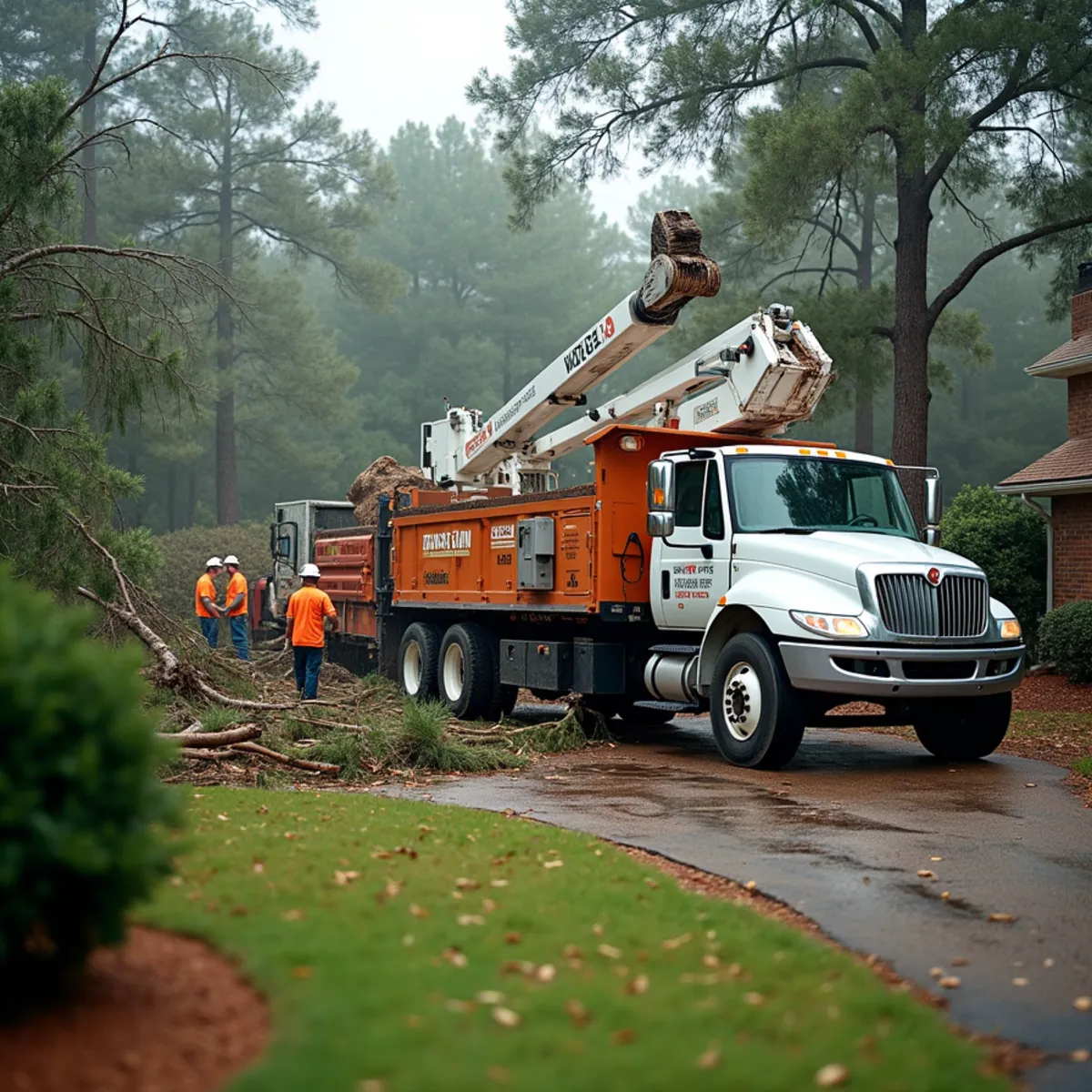
If a tree is touching a power line, treat it as energized. Keep people and pets back, call your utility first, and never climb, cut, or approach the tree. Then call us at (855) 615-0568 — we answer 24/7 and triage the hazard by phone.
Storm cleanup looks like grunt work, but the dangerous part is invisible: tension. A trunk pinned across a fence, a limb bent under load, a partially uprooted tree resting against another, all store energy that releases the instant you make the wrong cut. That is why we do not just start sawing the nearest log. We read each piece, identify what is loaded and how, and release tension in a controlled sequence, clearing overhead hangers before anyone works underneath. Doing it in the wrong order is exactly how homeowners get hurt after the storm has already passed.
Atlanta's storm mix is hard on trees: summer thunderstorms and downbursts, the occasional tornado remnant, and winter ice that coats the canopy and snaps limbs under the weight. Add mature oaks and pines, dense neighborhood canopy, and red-clay soil that turns loose after days of rain, and a single system can leave whole streets full of downed wood. When we arrive, we assess the whole property first, prioritize anything still threatening the house or blocking access, and then work methodically through the rest.
Cleanup and emergency response are two sides of the same event. If a hazard is still active, a tree on the roof or a line down, that is triaged first through our 24/7 emergency service before general cleanup begins. Once the immediate danger is controlled, we handle the volume: cutting downed trees into manageable sections, chipping brush, and hauling debris. A leaning or damaged tree that survived the storm may still need evaluation, so we flag anything worth a hazard assessment rather than assuming it is fine because it is still standing.
We work throughout Atlanta and the wider tree service in Fulton County area, and we document the damage and our work as we clear, which is what your adjuster will need. When a storm causes real property damage, cleanup usually runs alongside an insurance claim, and we keep the paperwork clean so you are not reconstructing the timeline from memory weeks later.
Storm damage we clear
- Whole trees or large limbs down across the yard, fence, or driveway.
- Limbs hung up in the canopy that could still fall on people or property.
- Trees leaning or partially uprooted and resting under tension.
- Split trunks, broken leaders, and cracked major unions after high wind.
- Ice- or wind-loaded branches bent and pinned against structures.
- General debris fields of brush, branches, and wood blocking access.
Need storm damage cleanup in Atlanta?
Free estimates · 24/7 emergency line · Licensed & insured
Our storm damage cleanup process
Whole-property assessment
We walk the site and identify what is still hazardous: active threats to the house, blocked access, energized lines, and trees or limbs under tension that must be released carefully.
Hazard prioritization
Anything still threatening a structure or trapping access is handled first, coordinating with the utility if a line is involved, before we move to general debris.
Controlled tension release
Loaded trunks and limbs are cut in a planned sequence to release stored energy safely, and overhead hangers are removed before anyone works beneath them.
Cutting and hauling
Downed trees are sectioned, brush is chipped, and debris is hauled or stacked per the scope. We note any surviving tree that needs a follow-up hazard assessment.
Documentation and walkthrough
We document the damage and work for your insurer, then walk the cleared property with you to confirm the debris plan was met before final payment.
What affects the price
Storm cleanup is priced by the volume and the danger, and the tension in the debris matters as much as the tonnage.
- Volume of downed wood, brush, and debris to cut and remove.
- How much material is under tension or hung up overhead versus loose on the ground.
- Trees still threatening structures or blocking access that must go first.
- Utility involvement requiring coordination before cleanup.
- Whether debris is chipped, hauled off, or stacked on site.
- Access for equipment and how far material must be moved to haul it.
Market context: Debris hauling is sometimes cited around $80 and chipping around $100 as reference points, but storm jobs vary widely with volume and hazard. Treat any figure as market context, not a quote.
Why homeowners choose Your Tree Expert
- Trained tension-release sequencing so cleanup does not become a second accident.
- Coordination with utilities and our emergency line for active hazards.
- Damage and work documented for your insurance claim as we go.
- Local crews who show up after Atlanta storms and clear the whole property.