
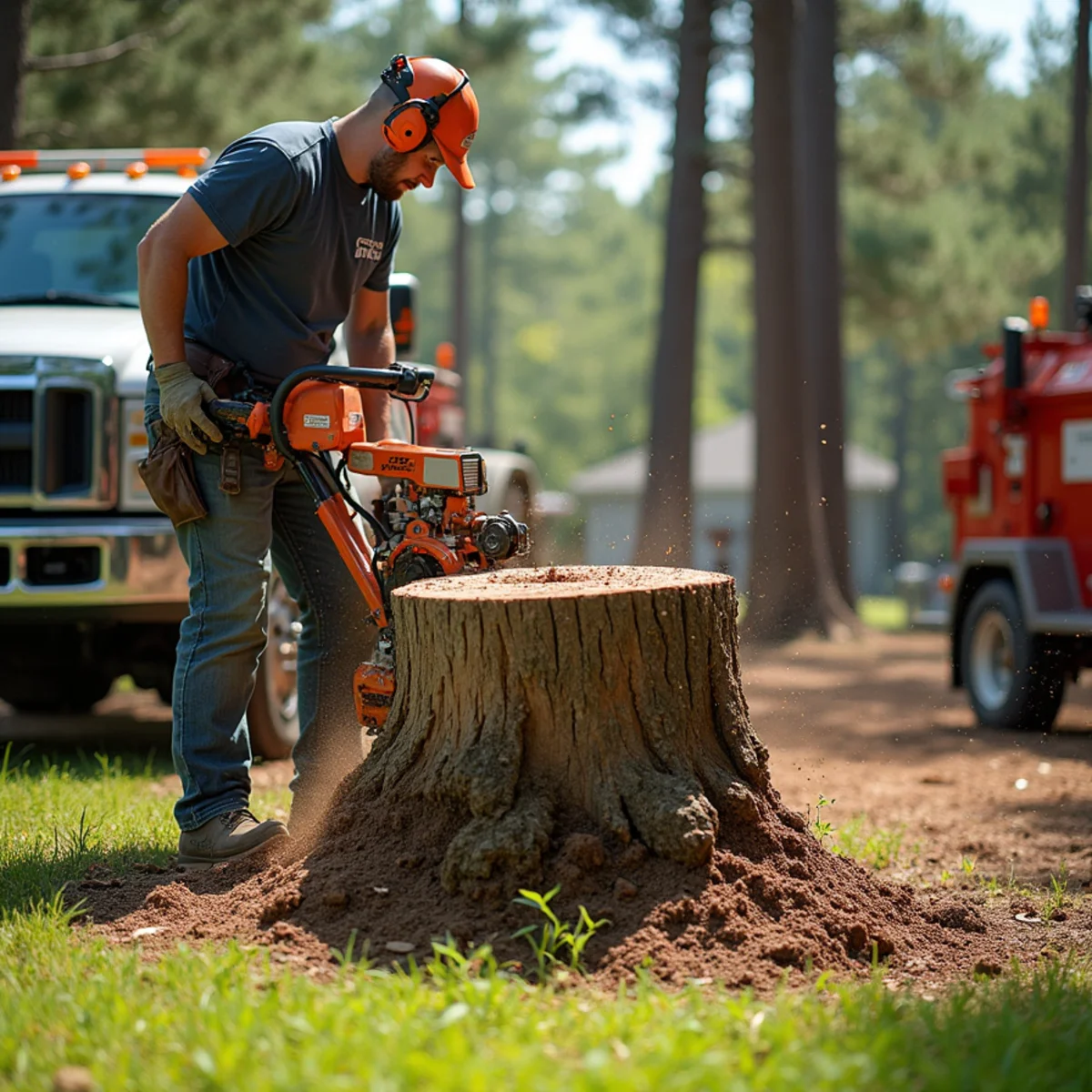
Grinding is the practical way to get rid of a stump, and it is important to understand what it does and does not do. A grinder chews the stump and its major surface roots down into mulch, commonly to a depth of about 12 to 18 inches, which is enough to replant grass, lay sod, or plant a shrub nearby. What it does not do is chase and extract every lateral root running out under the lawn; those are left to decompose naturally in the soil. Setting that expectation up front is why our scope always states the target grinding depth in writing.
In Atlanta's red-clay soil, an old stump left in the ground stays wet, softens, and becomes an ideal harbor for termites, carpenter ants, and fungal decay. When that stump sits within a few feet of the foundation, the pest risk becomes a house problem, not just a yard problem. Grinding removes that food source and lets you close the ground back up. If the stump is a leftover from a removal we did not perform, no problem: we grind stumps from any prior job across Atlanta and the greater tree service in Fulton County area.
Access drives a lot of stump work. A grinder needs a path to the stump, and narrow gates, steep slopes, or a stump boxed in by a patio and a fence all change the machine we bring and the time it takes. We size the equipment to the opening, protect the turf on the way in, and grind close to walls and hardscape as the site allows. Grinding pairs naturally with a full tree removal, and many homeowners have us handle both so the tree and its stump are gone in a single visit.
When you are clearing several stumps to reclaim a section of yard or prep for a new build, grinding often folds into a larger lot and land clearing scope. Either way, we finish by telling you exactly what happens to the grindings, whether surface roots and soil are addressed, and when the walkthrough occurs, so nothing about the finished ground surface is a surprise.
Signs it is time to grind a stump
- A leftover stump you keep hitting with the mower or tripping over in the yard.
- Surface roots heaving up through the lawn and cracking nearby walks or driveway.
- Suckers and sprouts pushing up from an old stump or its roots.
- A rotting stump within a few feet of the house drawing termites or carpenter ants.
- Soft, fungal, or mushroom-covered wood signaling the stump is decaying in the clay.
- A stump in the way of new sod, a bed, a fence line, or a build.
- Old stumps left behind from a removal done by someone else.
Need stump grinding & removal in Atlanta?
Free estimates · 24/7 emergency line · Licensed & insured
Our stump grinding & removal process
Stump and access review
We measure the stump, check for rocks, metal, or irrigation lines around it, and confirm the machine can reach it through gates, slopes, or hardscape. Utility locates are considered before grinding near buried lines.
Written depth and debris scope
The scope states the target grinding depth, whether grindings are backfilled or hauled, and whether surface roots, soil, and grading are included. Pricing basis (diameter, count, or access) is spelled out.
Setup and protection
We lay down protection along the machine path, clear the area of stones and debris that could throw, and set a safe zone around the grinding operation.
Grinding below grade
The stump and major surface roots are ground down to the agreed depth, commonly around 12 to 18 inches, producing a mulch of wood chips and soil.
Backfill and cleanup
Grindings are used to backfill the hole or hauled away per the scope, the area is raked smooth, and we review the finished grade with you.
What affects the price
Stump pricing usually tracks the stump's size and how hard it is to reach, plus what you want done with the grindings.
- Stump diameter measured at ground level, and the number of stumps.
- Target grinding depth and whether surface roots are chased out.
- Access to the stump through gates, over slopes, or around patios and fences.
- Whether grindings are backfilled on site or hauled away.
- Presence of rocks, old concrete, fill, or debris grown into the root ball.
- Optional soil, grading, seed, or sod to finish the spot for replanting.
Market context: Published Atlanta stump-grinding benchmarks commonly run $130-$430, with some stump-removal figures cited at $150-$500. Those are context ranges, not a quote.
Why homeowners choose Your Tree Expert
- Written target depth so you know exactly how far below grade the stump goes.
- Right-sized machines for tight gates, slopes, and stumps against hardscape.
- Local, licensed, and insured crews rated 4.9 stars across 168 reviews.
- Clear plan for grindings, surface roots, and finished grade before we start.