If a tree is touching a power line, treat it as energized. Keep people and pets back, call your utility first, and never climb, cut, or approach the tree. Then call us at (855) 615-0568 — we answer 24/7 and triage the hazard by phone.
An emergency starts with your safety, not a chainsaw. The first move when a tree fails is to get people and pets away from it, keep everyone out of the likely fall path, and stay clear of any limb resting on a structure or under tension. If a line is involved, assume it is energized and call the utility first; a downed conductor can stay dangerous even after the neighborhood loses power. When you call us, we triage over the phone, tell you what to isolate, and plan the approach before anyone touches the tree.
Atlanta generates its own steady supply of tree emergencies. Thunderstorms, tornado remnants, and winter ice all load mature oaks and pines past their limit, and saturated red-clay soil lets root plates lift when a tree that stood for decades finally goes over. In a widespread storm, call volume spikes and everyone wants a crew at once, so we triage by severity: trees on occupied structures, blocked-in access, and utility involvement come before a limb down in an open yard. A 60-minute callback or triage response is available when operations support it, but physical arrival depends on safety, storm volume, roads, and access.
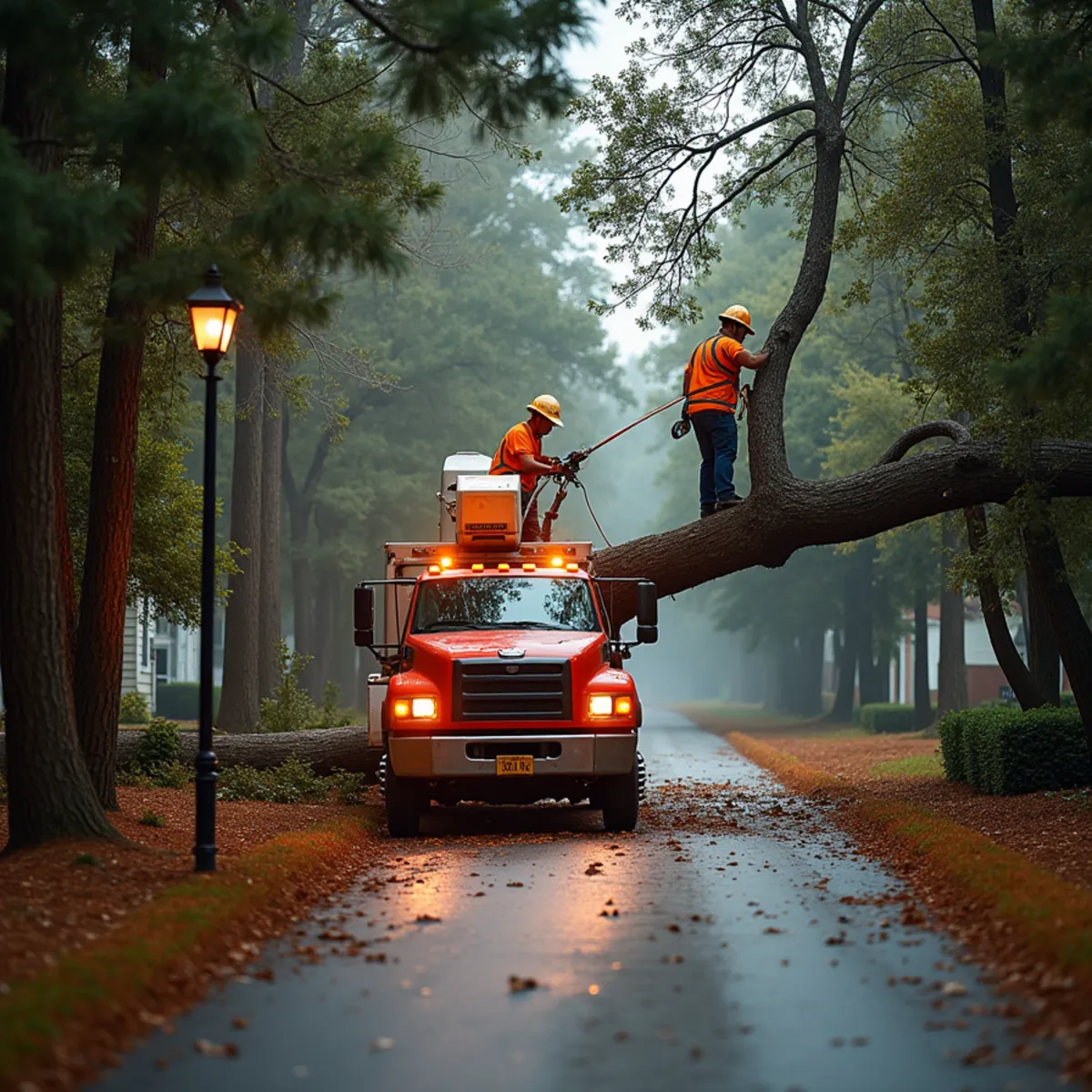
Our emergency work is controlled work, not cowboy work. Even at night and under pressure, sections are rigged and lowered rather than dropped, exclusion zones are set, and the crew follows ANSI Z133 safety practices. Many emergencies are really two jobs: stabilizing the immediate hazard tonight, then completing the full storm damage cleanup once the site is safe and daylight allows. If the tree is on the structure itself, it becomes a specialized fallen tree on house operation with heavier rigging or a crane.
We respond across Atlanta and the broader tree service in Fulton County service area, and we document the event as we go, which matters when an insurance claim follows. For a broken branch hung up in the canopy over a walkway rather than a whole tree down, that is often handled faster as hanging limb removal. Whatever the situation, call first and let us tell you whether it is an isolate-and-wait or a come-now.
Call the emergency line when
- A tree or large limb has fallen on your house, garage, or vehicle.
- A tree is leaning on or contacting a power line or service drop.
- A trunk has split or a tree is uprooting and held only by tension.
- A fallen tree is blocking your only driveway, road, or exit.
- A large limb is hung up in the canopy over an area people use.
- A storm has left a tree visibly unstable next to an occupied structure.
- Cracking or popping sounds are coming from a leaning tree after heavy rain.
Need 24/7 emergency tree service in Atlanta?
Free estimates · 24/7 emergency line · Licensed & insured
Our 24/7 emergency tree service process
Phone triage
Call and we assess the hazard with you: what failed, what it is threatening, whether a utility line is involved, and whether the site can wait for daylight. We tell you what to isolate immediately.
Utility and safety first
If a line or utility equipment may be involved, the utility is contacted first. We do not approach an energized hazard, and we keep you and your household out of the danger zone.
Dispatch and access plan
We prioritize by severity and dispatch a crew as conditions allow, planning the access route, rigging, and whether a crane is needed before arrival.
Controlled stabilization
On site, the crew sets an exclusion zone and removes or secures the immediate hazard under control to ANSI Z133 practices, protecting the structure and surrounding property.
Documentation and follow-up
We document the event and the work for your insurer and scope any remaining cleanup, which is often completed as a follow-up visit once the site is safe.
What affects the price
Emergency pricing reflects the urgency, the hazard, and the equipment the situation demands rather than a routine rate.
- Time of day, weather, and whether the response is during an active storm event.
- Severity: a tree on a structure versus a limb down in an open area.
- Utility involvement requiring coordination before work can begin.
- Rigging, crane, or heavy equipment needed to stabilize safely.
- Size and species of the failed tree and how it is loaded or under tension.
- Immediate stabilization only versus full removal and cleanup in one visit.
Market context: Emergency and after-hours work carries different economics than scheduled removal, and complex storm jobs can exceed ordinary residential figures. Any numbers we mention are market context, not a quote; the written scope follows the on-site assessment.
Why homeowners choose Your Tree Expert
- Phone answered around the clock with real hazard triage, not an answering machine.
- Controlled, ANSI Z133 rigging even under emergency pressure.
- Local Atlanta crews since 2020, rated 4.9 stars across 168 reviews.
- Event documentation to support the insurance claim that often follows.