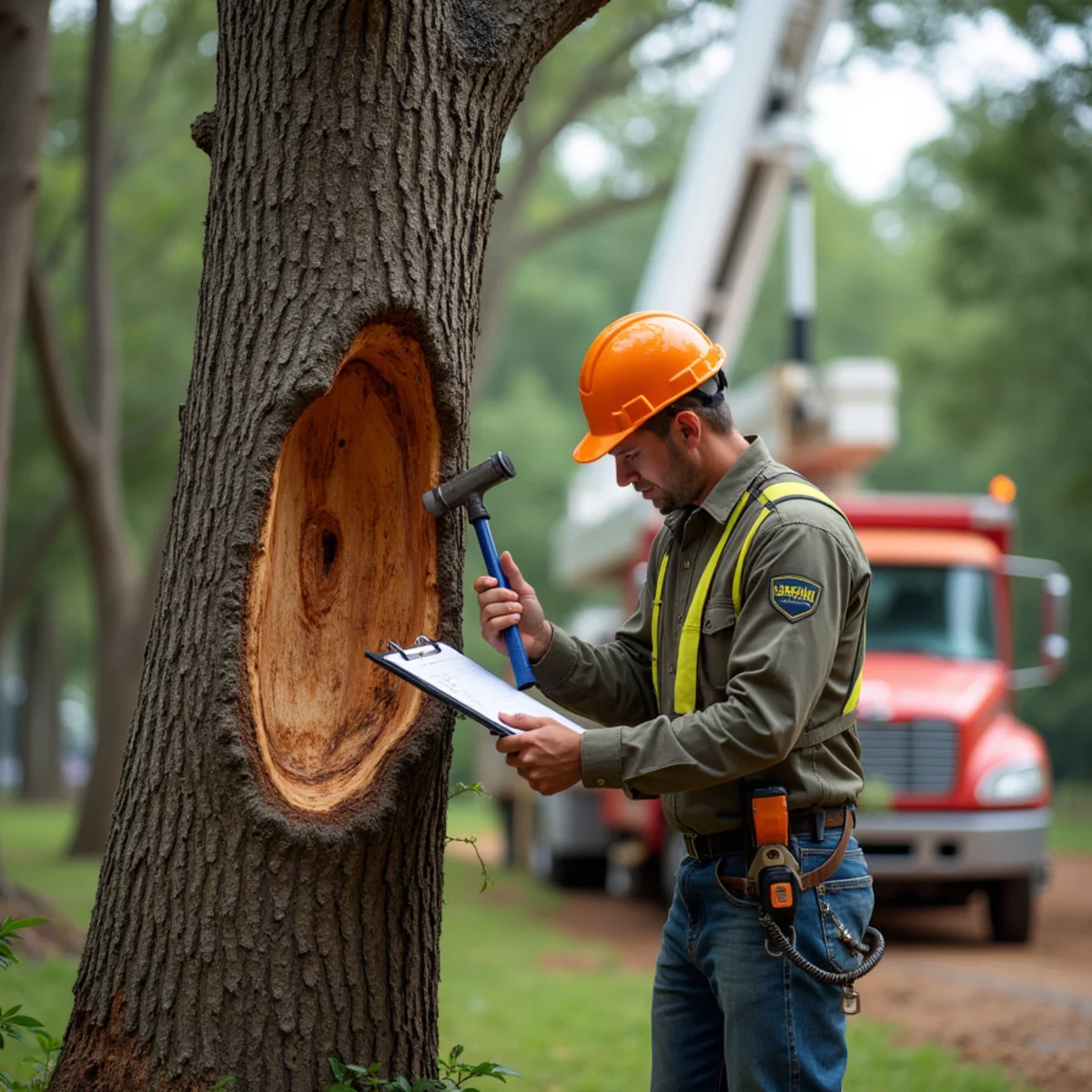
A hazard is a combination of two things: a defect that could fail and a target that would be hit if it did. A hollow, leaning oak in the middle of a vacant field is not much of a hazard; the same tree over a child's bedroom is a serious one. Our assessment evaluates both sides of that equation. We inspect the root flare, the trunk, the major unions, and the crown for decay, cavities, cracks, weak attachments, and deadwood, then weigh the likelihood of failure against what sits in the fall path.
You cannot diagnose a tree from a photo, and you cannot always see the problem from the ground. Atlanta's mature water oaks and pines can carry advanced internal decay behind sound-looking bark, and red-clay soil that stays saturated after a wet spell can quietly loosen a root plate. We look for the subtle signals, a slightly lifted soil ring, a seam of fungal conks, a shift in a lean, that tell us the tree is moving toward failure. Where the reading is ambiguous, we say so and recommend monitoring rather than pretending to false certainty.
The value of the assessment is the recommendation. If a tree can be saved with structural pruning or a support cable, that is almost always cheaper and better than removal, and we will tell you that even though removal is the bigger job. If the defect is severe, we document why removal is warranted and can move straight into a planned tree removal. When the concern is insect or disease driven, such as bark beetles in a stressed pine, we fold in what we know from pine beetle and diseased tree work to make the call.
Homeowners across Atlanta use these assessments to plan before storm season, to settle a dispute with a neighbor about a shared tree, or to satisfy an insurer or HOA that a tree was evaluated by a professional. After a storm blows through the tree service in Fulton County area, an assessment also helps you triage which trees need immediate attention and which are safe to leave, so you are not paying for storm damage cleanup on trees that were never actually a threat.
Warning signs worth an inspection
- A lean that appears new or has visibly increased, with cracked or heaving soil at the base.
- Mushrooms, brackets, or conks at the root flare, trunk, or major branch unions.
- A cavity, hollow sound when tapped, or soft, punky wood in the trunk.
- Deep vertical cracks, seams, or a bulge running up the main stem.
- Large deadwood in the crown or a dead top that keeps expanding.
- Two or more codominant stems joined by a tight, included-bark union.
- Roots cut or paved over by recent construction, trenching, or driveway work.
Need hazardous tree assessment in Atlanta?
Free estimates · 24/7 emergency line · Licensed & insured
Our hazardous tree assessment process
Site and target review
We start by identifying what the tree could hit: the house, a driveway, a play area, a neighbor's structure, or a utility corridor. The target determines how much a given defect actually matters.
Ground-based inspection
We examine the root flare, trunk, unions, and crown for decay, cavities, cracks, weak attachments, and deadwood, and check the soil around the base for movement or heaving.
Advanced checks when needed
Where a defect is suspected but not visible, we may sound the trunk, probe a cavity, or recommend further diagnostics before reaching a conclusion, rather than guessing.
Written recommendation
You receive a clear written finding: prune, cable or brace, treat, monitor on a schedule, or remove, with the reasoning and the level of urgency spelled out.
Next-step planning
If action is warranted, we scope it directly, whether that is corrective pruning, a support system, or a planned removal, so you can move from finding to fix without starting over.
What affects the price
An assessment is priced for the arborist's time and the depth of inspection, and it is a small cost next to the risk of a wrong guess.
- Number of trees being evaluated on the property.
- Tree size and whether an aerial inspection is needed to read the upper crown.
- Complexity of the defect and whether advanced diagnostics are warranted.
- Whether a written report is needed for an insurer, HOA, or neighbor dispute.
- Travel and access across the property.
- Follow-up monitoring visits if the recommendation is to watch rather than act.
Market context: Assessment fees vary with scope, and the finding often saves money by preventing an unnecessary removal or catching a real hazard early. Any removal or pruning that follows is quoted separately as market-context work, not a guaranteed price.
Why homeowners choose Your Tree Expert
- Recommendations from ISA-informed arborists who assess risk to ANSI standards, not a removal quota.
- Honest prune-versus-remove guidance, even when the smaller job is the right answer.
- Written findings you can hand to an insurer, adjuster, or HOA.
- Local crews who know how Atlanta soils, storms, and species drive tree failure.