
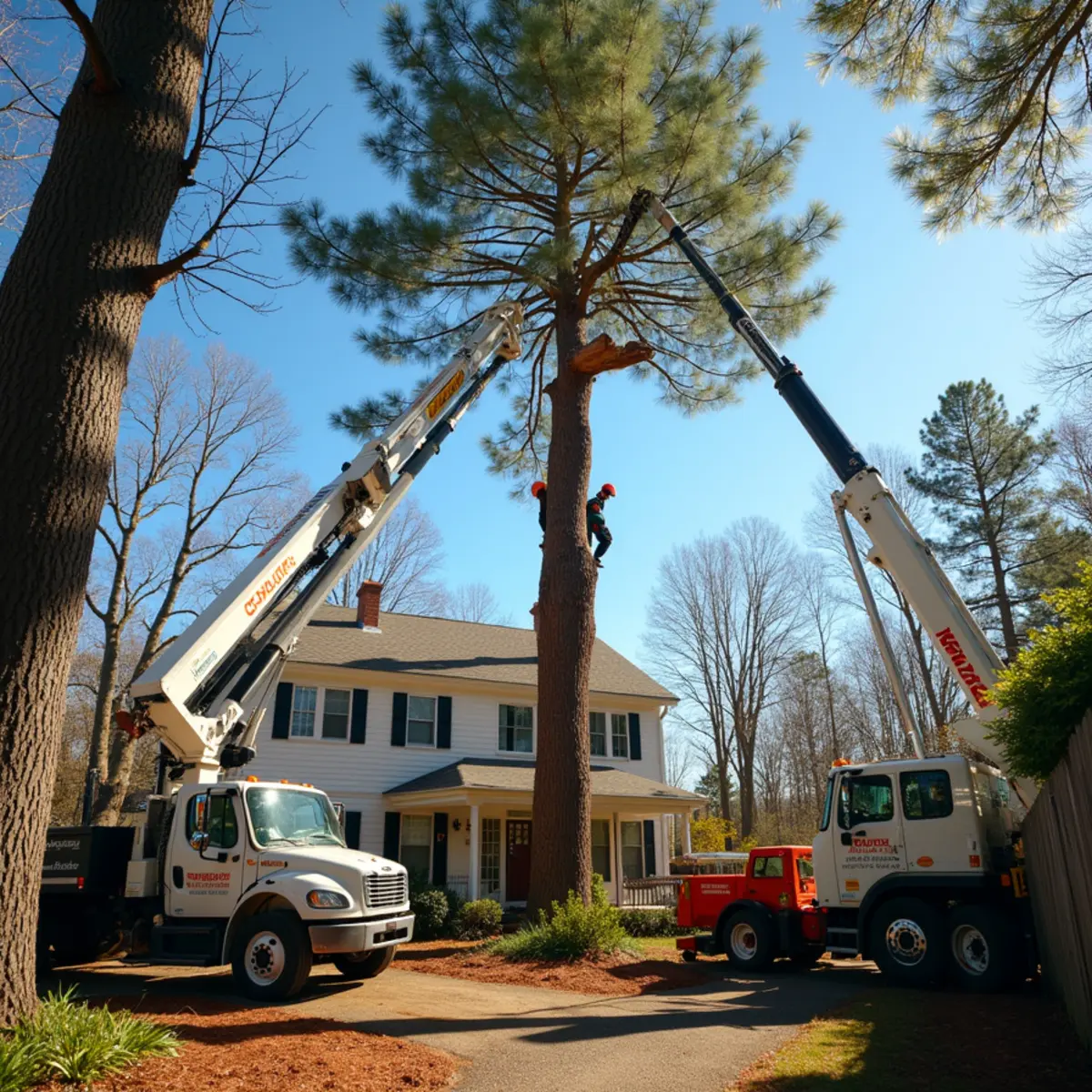
A crane is not a luxury on every job, but on the right job it is the difference between a clean removal and a risky one. When a huge water oak sits in a fenced backyard with a house on one side and the neighbor on the other, conventional rigging means lowering heavy pieces through a very small window, over and over, with everything you want to protect directly underneath. A crane removes that risk. We attach to a section, the climber makes the cut, and the piece is lifted straight up and out to a drop zone in the open, never traveling across your roof at all.
Crane work shines in exactly the conditions Atlanta creates. Older neighborhoods have enormous mature hardwoods and pines wedged into lots that were never designed around them, with narrow side yards, no rear access, and structures close on every side. A dead or decayed tree makes climbing more dangerous still, because the wood a climber depends on may not be sound. Lifting sections with a crane keeps the climber's exposure short and the load fully controlled, which is safer for the crew and for everything on the ground.
The trade-off is planning and space. A crane needs a set-up spot with the reach and clearance to make the picks, so we assess staging, overhead lines, ground conditions, and the drop zone before we commit to the approach. When a tree is genuinely craneable, though, the job is usually faster and tidier than a full climb-and-rig, and it is frequently the method behind a difficult tree removal or a fallen tree on a house where weight must come off a structure without dragging.
We bring crane capability to jobs across Atlanta and the wider tree service in Fulton County area, and it is a core part of our storm response, since the biggest failures often land in the worst spots. After a major event, a crane can clear in an afternoon what would take days to rig by hand, which is why crane work and storm damage cleanup so often go together. Every crane job runs to ANSI Z133 safety practices with a written lift plan.
When a crane is the right call
- A very large hardwood or pine in a fenced or rear backyard with no equipment access.
- A tree surrounded by structures where rigged sections would travel over the roof.
- A dead or decayed tree that is unsafe for a climber to work from.
- A storm-failed tree too heavy or tangled for safe conventional rigging.
- A tree resting on a house where weight must be lifted up and away.
- Multiple large removals where crane speed limits time over sensitive areas.
Need crane-assisted tree removal in Atlanta?
Free estimates · 24/7 emergency line · Licensed & insured
Our crane-assisted tree removal process
Craneability assessment
We evaluate the tree's size and condition, the crane set-up spot, reach and clearance, overhead lines, ground conditions, and a safe drop zone to confirm a crane is the right method.
Written lift plan
You receive a scope describing the pick sequence, section weights, staging, property protection, and access assumptions. Any change to the plan requires approval before proceeding.
Set-up and protection
The crane is positioned and stabilized, exclusion zones are set, and we protect turf, driveways, and structures in the staging and drop areas.
Pick-and-cut removal
The climber attaches and cuts each section while the crane holds the load, then lifts it straight up and out to the drop zone, keeping weight off everything below.
Ground processing and cleanup
Sections are processed at the drop zone, debris is chipped or hauled per the scope, and we walk the site with you to confirm the result.
What affects the price
Crane removals are priced for the equipment and the plan, and often the crane pays for itself by cutting time over sensitive areas.
- Tree size and estimated section weights the crane must handle.
- Crane size required and how long it is on site.
- Set-up access, reach, and whether the crane can stage close to the tree.
- Overhead utilities and clearances affecting the lift.
- Condition of the tree and the complexity of the pick sequence.
- Debris volume and whether material is chipped or hauled.
Market context: Crane removal of a large hardwood sits at the upper end of removal ranges, with large-tree figures often cited around $800-$2,500 and complex jobs beyond. Those are context ranges, not a quote for your tree.
Why homeowners choose Your Tree Expert
- Crane capability for the biggest, most boxed-in Atlanta hardwoods.
- Written lift plans and ANSI Z133 safety on every pick.
- Faster, cleaner removals over roofs and fences than climb-and-rig alone.
- Local, licensed, insured crews rated 4.9 stars across 168 reviews.