
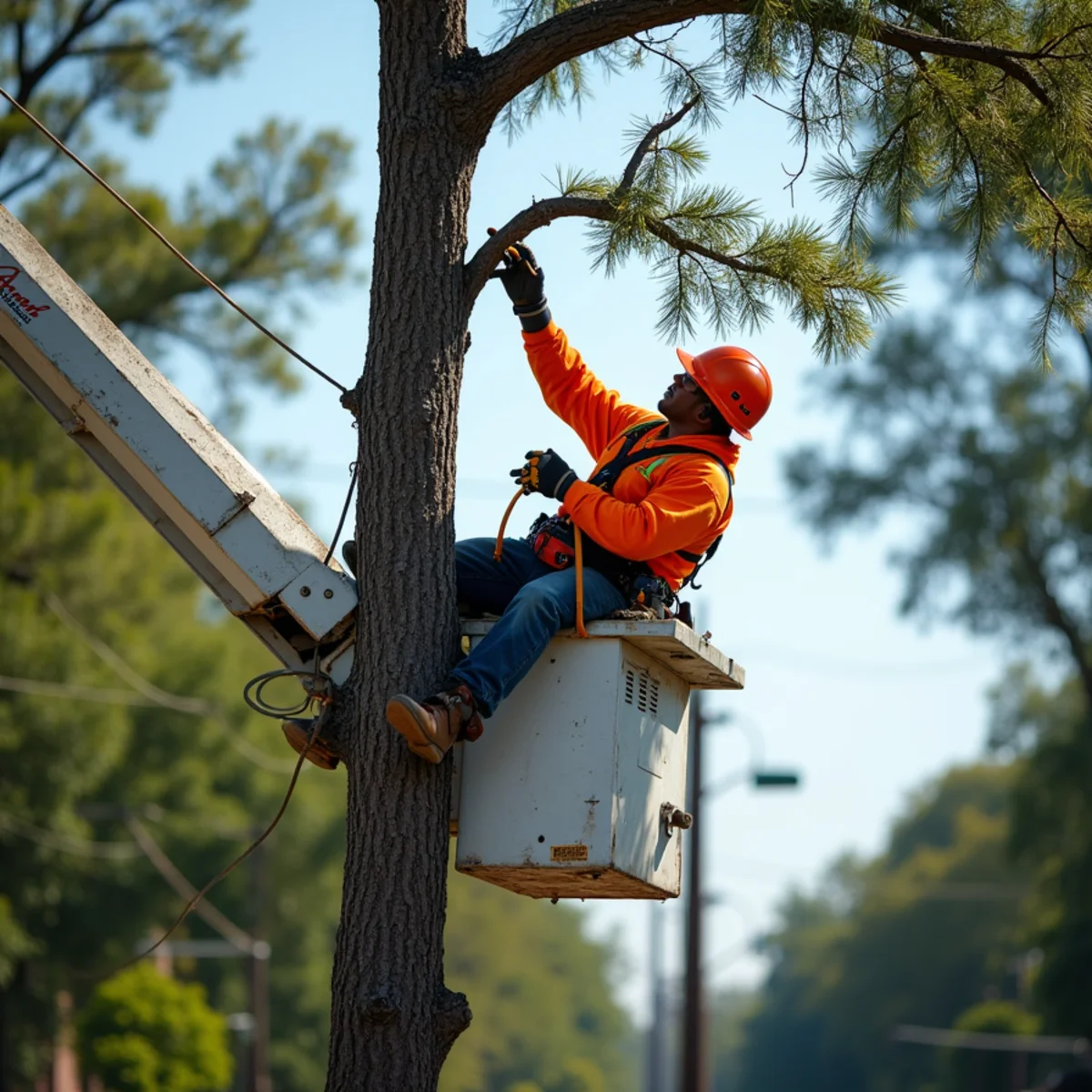
Any tree near a power line changes the rules, because a limb touching a conductor has to be assumed energized until the utility says otherwise, and a line can stay dangerous even when the neighborhood has lost power. That is why utility-line clearance is a distinct service and not just ordinary trimming. It calls for maintaining safe approach distances, using the right insulated tools and techniques, and prioritizing electrical safety over aesthetics. A homeowner on a ladder with a pole saw near a service drop is one of the most dangerous situations in yard work.
The first thing to sort out is whose line it is. In most cases the utility maintains clearance around its primary distribution lines, while the service drop, the line running from the pole to your house, and the trees around it are a gray area that often falls to the property owner. We help you understand which is which, and if a limb is on a primary line, the right move is to call the utility, not to have us cut it. For the lines and drops that are yours to manage, we prune to safe clearances and keep the tree healthy in the process.
Clearing near lines is really specialized pruning, so it connects directly to our tree trimming and pruning work, just with an added layer of electrical safety. It also comes up constantly in storms, when limbs blow into drops and tangle with conductors, which ties into our storm damage cleanup response. In those cases the sequence is always utility first, tree crew second, because approaching a line-involved tree before the utility clears it is exactly the mistake that gets people hurt.
We handle line-adjacent trimming for homeowners across Atlanta and the surrounding tree service in Fulton County area, working to ANSI Z133 safety standards. Where a line-side tree shows decay or a lean toward the wires, we will recommend a hazard assessment, because a compromised tree over a service drop is a higher-stakes failure than the same tree over open lawn. The goal is simple: keep your trees and your power both intact, without anyone taking a risk near live conductors.
Line-clearance situations we handle
- Limbs growing into or resting on the service drop to your house.
- Branches rubbing or arcing against a line, sometimes sparking in wind.
- Trees crowding the wires that feed your home, garage, or outbuilding.
- Storm-broken limbs tangled near a conductor or drop.
- A line-side tree leaning or showing decay toward the wires.
- Vegetation that repeatedly causes flickering or outages at your property.
Need utility line clearance in Atlanta?
Free estimates · 24/7 emergency line · Licensed & insured
Our utility line clearance process
Line ownership review
We identify which lines are the utility's primary responsibility and which service drops or trees fall to you, so you are not paying to touch something the utility should handle, or vice versa.
Hazard and clearance plan
We assess the tree, the conductors, and the approach distances, and plan the pruning to achieve safe clearance while keeping the tree structurally sound.
Safety setup
The crew treats line-adjacent limbs as energized until confirmed otherwise, uses proper tools and techniques, and coordinates with the utility when a primary line is involved.
Clearance pruning
Limbs are pruned back from the drop or line to safe clearance to ANSI Z133 and A300 standards, made as proper cuts rather than stubs so the tree recovers cleanly.
Cleanup and recommendation
Debris is chipped or hauled, and we flag any decayed or leaning line-side tree that warrants a fuller hazard assessment.
What affects the price
Line-clearance pruning is priced for the added safety, access, and coordination that energized conductors require.
- Height and reach to the limbs and whether a bucket or climb is needed.
- How close the work is to energized conductors and required approach distances.
- Whether utility coordination is required for a primary line.
- Amount of growth to clear and the number of trees involved.
- Condition of the tree and whether a hazard assessment is warranted.
- Debris volume and cleanup requirements.
Market context: Line-adjacent pruning is specialized work; general pruning is cited around $150-$500 as market context, and line proximity can raise it. That is not a quote.
Why homeowners choose Your Tree Expert
- Trained, insured climbers who treat every line as energized until proven otherwise.
- Clear guidance on which limbs are yours versus the utility's responsibility.
- ANSI Z133 and A300 practices for safety and clean, healthy cuts.
- Local crews who coordinate with utilities when a primary line is involved.